




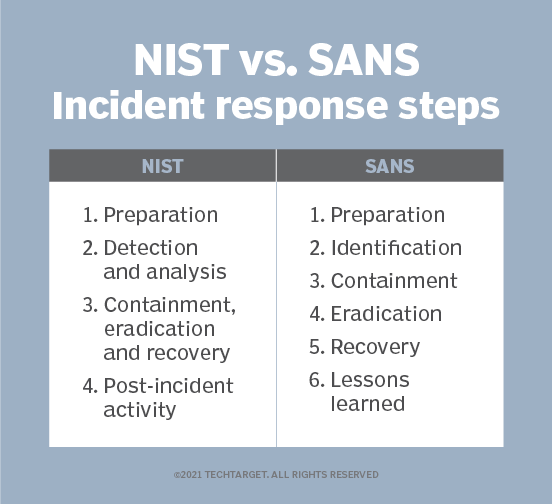
Clear and concise comparison between NIST and SANS (CIS Controls)
Comparison Table: NIST vs SANS (CIS Controls)
| Feature / Aspect | NIST Framework | SANS / CIS Controls |
|---|---|---|
| Full Name | NIST Cybersecurity Framework (NIST CSF) | SANS Top 20 / CIS Critical Security Controls |
| Developed By | U.S. National Institute of Standards and Technology (NIST) | Originally by SANS Institute, now managed by CIS |
| Purpose | Provide comprehensive cybersecurity risk management guidance | Provide prioritized, actionable security controls |
| Approach | Top-down (strategic, policy-driven) | Bottom-up (practical, control-driven) |
| Focus Area | Risk management, governance, policy, lifecycle | Technical controls and security hygiene |
| Complexity | Higher – broader and strategic | Moderate – focused and actionable |
| Flexibility | Highly customizable | More prescriptive and straightforward |
| Compliance Use | Suitable for compliance (e.g., FISMA, HIPAA, DFARS) | Suitable for quick wins and foundational security |
| Structure | 5 Core Functions: Identify, Protect, Detect, Respond, Recover | 18 Controls (as of CIS v8) categorized by Implementation Group |
| Ideal For | Large enterprises, regulated industries, government agencies | Small to mid-sized businesses, IT/security teams |
| Documentation | NIST SP 800 series, especially SP 800-53 and SP 800-171 | CIS Controls documentation and implementation guides |
Summary
-
NIST is best for building a broad, risk-based cybersecurity program and aligning with regulations.
-
SANS / CIS Controls are ideal for quick, technical implementation of essential security practices.
Use Cases
| Organization Type | Recommended Framework |
|---|---|
| Government agency | NIST |
| Enterprise with compliance needs | NIST |
| Small/medium business | SANS / CIS Controls |
| Technical IT/security team | SANS / CIS Controls |